The Impact of Proof of Authorship (POA)
Part 6 of 6
Introducing POA marks a shift from symbolic protection to evidentiary certainty. By combining blockchain anchoring, IPFS content addressing, and quantum‑resistant encryption into a reproducible protocol, POA delivers a new baseline for how authorship is established, defended, and leveraged.
For Creators
- Leverage in Negotiation: Instead of relying on assertion, creators present a POA Record—an immutable, independently verifiable artifact.
- Privacy with Control: Works remain sealed until disclosure, ensuring creators decide when and how to reveal their intellectual property.
- Durability: Unlike fragile physical evidence, POA Records persist across a decentralized network, immune to loss or tampering.
For Publishers and Institutions
- Reduced Risk: Submissions anchored in POA simplify due diligence by providing a reproducible chain of custody.
- Operational Efficiency: Verification shifts from subjective evaluation to objective confirmation, lowering administrative overhead.
- Interoperability: As a protocol, POA can integrate with existing rights management and archival systems without disruption.
For Courts and Legal Proceedings
- Reproducibility: POA Records are generated through a transparent process that can be independently verified.
- Tamper‑Evident: Any alteration to a work produces a new content address, making manipulation immediately visible.
- Designed for Admissibility: The protocol is built to meet the reliability requirements of evidentiary rules such as FRE 901(b)(9).
From Dispute to Verification
Authorship disputes no longer depend on testimony, memory, or symbolic gestures. With POA, they reduce to a matter of verification: Does the record exist, and does it match the work in question? This shift doesn’t eliminate conflict, but it transforms the evidentiary ground on which conflicts are resolved.
POA is not just protection. It is leverage. It gives creators a durable evidentiary foundation, publishers a reliable submission framework, and courts a reproducible standard of proof. In doing so, it replaces the myth of the sealed envelope with a system of evidence designed for the digital age.
Closing Summary: The Bigger Picture
POA Protocol and POA Record are the first operational modules of Raptoreum’s Intellectual Property Protection System (IPPS). IPPS is the platform that makes POA possible: a modular, defense‑in‑depth architecture that ties specific technologies to specific evidentiary functions.
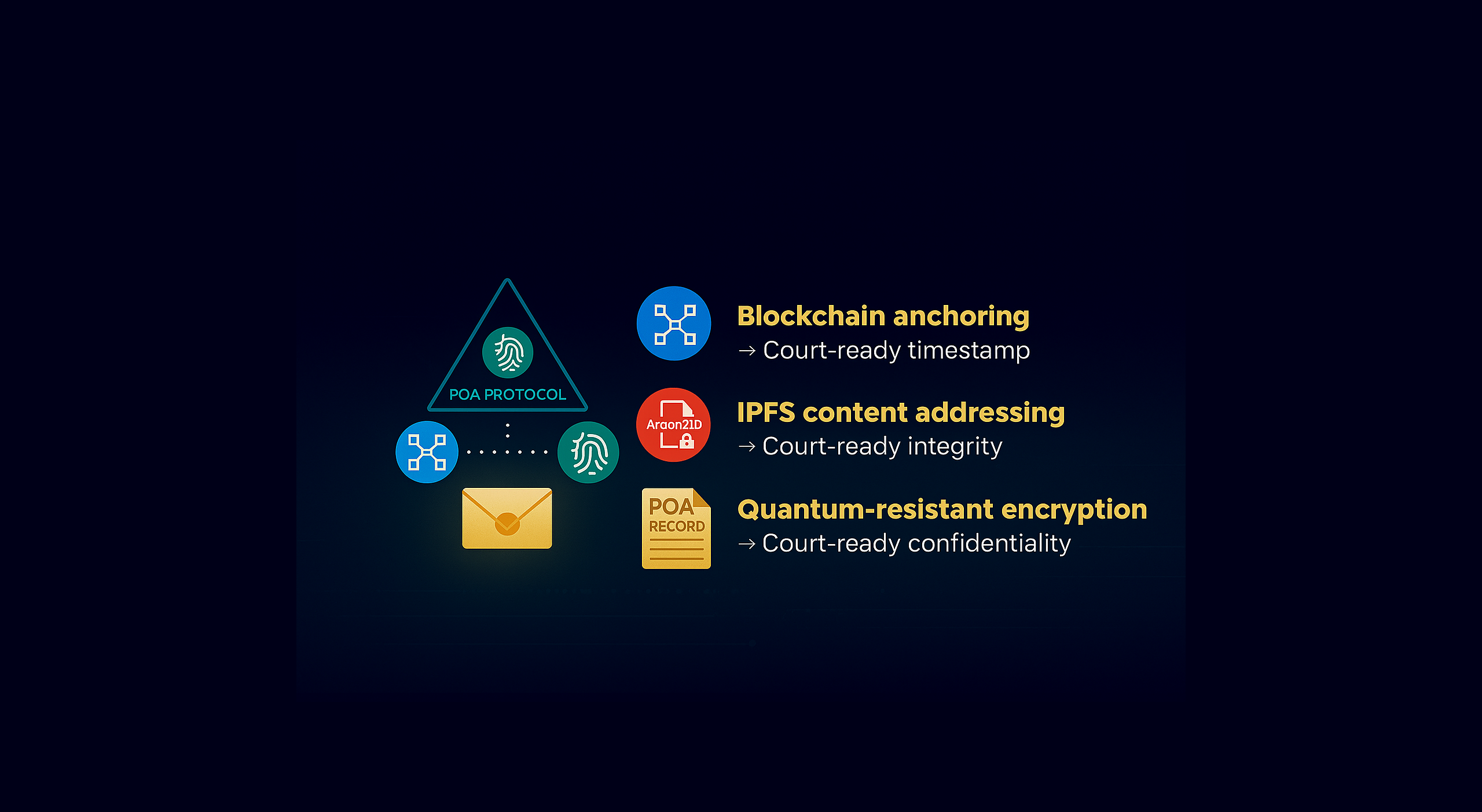
- Blockchain anchoring → Court‑ready timestamp
Every POA Record carries an immutable, independently verifiable timestamp that demonstrates when a work existed. - IPFS content addressing → Court‑ready integrity
Each work is bound to a content‑derived cryptographic hash so courts and verifiers can confirm what the work contained at the time of anchoring. - Quantum‑resistant encryption → Court‑ready confidentiality
Sealed containers preserve access control and confidentiality while maintaining verifiability when disclosure is required. - Decentralized permanence → Court‑ready durability
Distributed storage ensures the proof remains available and tamper‑evident regardless of single‑node failures.
Together, these layers make IPPS court‑ready by design. Where Poor Man’s Copyright offered psychological comfort, IPPS provides a reproducible chain of proof suitable for negotiation, institutional due diligence, and legal authentication.
IPPS is more than a protocol or recordset: it is infrastructure for creative evidence at scale. Using POA as its first module, the shift for creators, publishers, and courts is from trust to proof, in a system that’s anchored, distributed, and built to last.
This is the shift: from isolated acts of protection to a civilization‑scale infrastructure for creative evidence.