
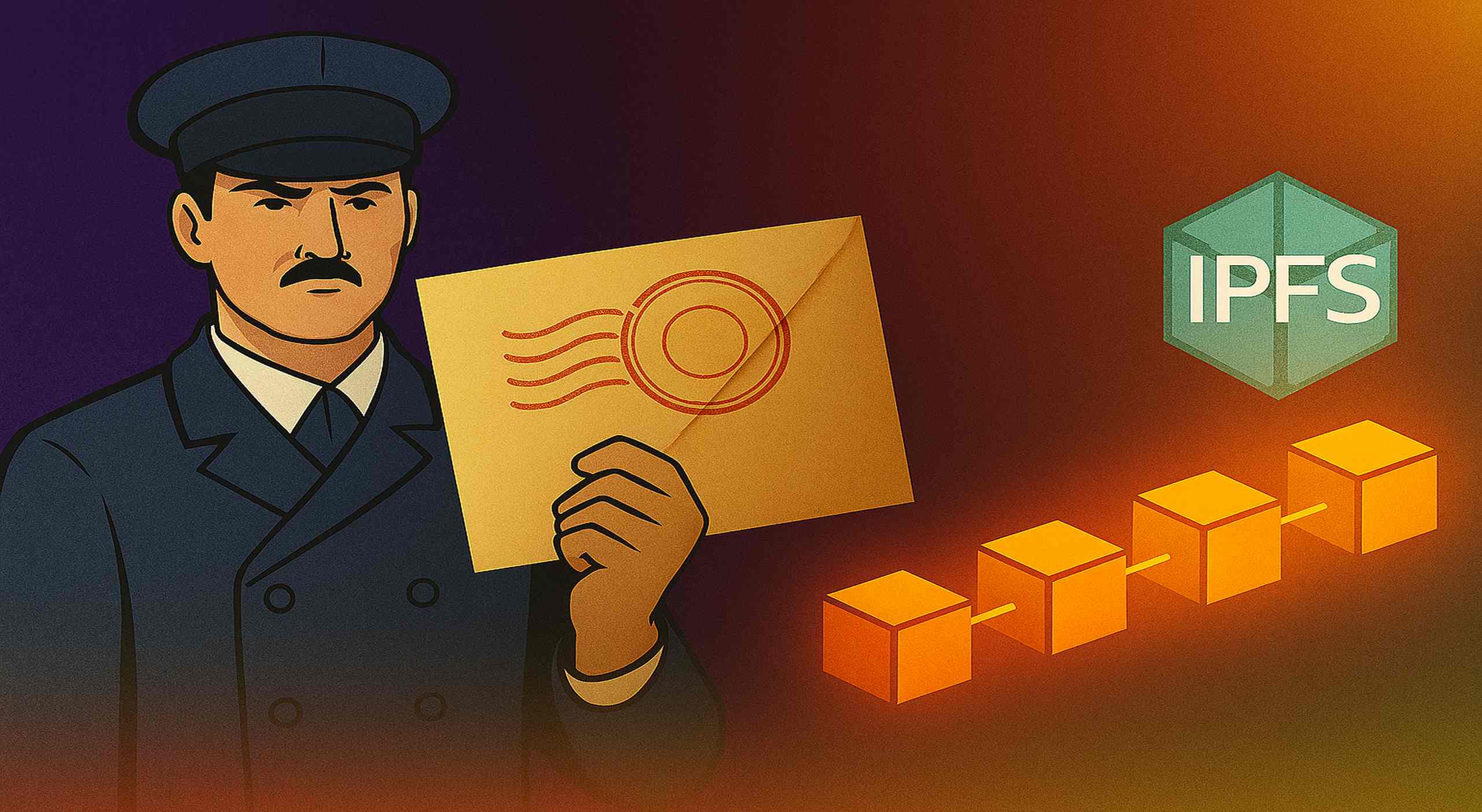
The Evolution of Proof: From Postmarks to Blockchains
Part 3 of 6
For centuries, creators have relied on trusted third parties to establish when a work existed. Postal services provided postmarks, government‑verified timestamps that were difficult to falsify. Notaries and copyright offices extended this principle, offering standardized records that courts could rely on.
Digital technology introduced new forms of timestamping, but these were still vulnerable: centralized databases could be compromised, and file metadata could be altered with ease. What was missing was a system that combined permanence, transparency, and independence from any single authority.
Blockchain technology represents the next step in this chain of trust, but it’s important to note that not all blockchains are built alike. Some are permissioned or centrally controlled; others rely on consensus models that vary in strength. Only chains with broad decentralization and strong economic incentives provide the permanence and independence creators need.
When a record is anchored to such a blockchain:
- It receives a cryptographic timestamp that cannot be altered
- The record is distributed across thousands of independent nodes
- Any attempt to change it would require prohibitive computing power
- The timestamp is publicly verifiable by anyone, anytime
Paired with content addressing through IPFS (InterPlanetary File System), this creates a system where each file is identified by its unique digital fingerprint. Even the smallest change produces a new identifier, making tampering immediately visible.
The technological evolution follows an obvious pattern:
- Postmark: A single trusted authority confirms a date.
- Digital timestamp: A centralized system records a date.
- Blockchain anchor: A decentralized consensus secures the date.
- Content addressing: The work itself is locked to its fingerprint.
Each stage solves the weaknesses of the one before it. The postal service could lose mail; digital timestamps could be falsified; centralized databases could be hacked. Blockchain anchoring and content addressing provide a system where proof of existence is both immutable and independently verifiable.
The core need has never changed: creators must be able to show, “I had this work, in this exact form, on this date.” What has changed is the strength of the locks we can place on that proof.
In our next post, we’ll examine how Raptorlockip.com combines these technologies into a three-lock system that provides defense-in-depth protection for your intellectual property.