
Introducing Proof of Authorship (POA)
Part 5 of 6
The “Poor Man’s Copyright” was a ritual of comfort, not a system of evidence. Mailing yourself a sealed envelope might have felt protective, but it was never designed to withstand legal or commercial scrutiny. Today, creators need proof that is reproducible, verifiable, and admissible.
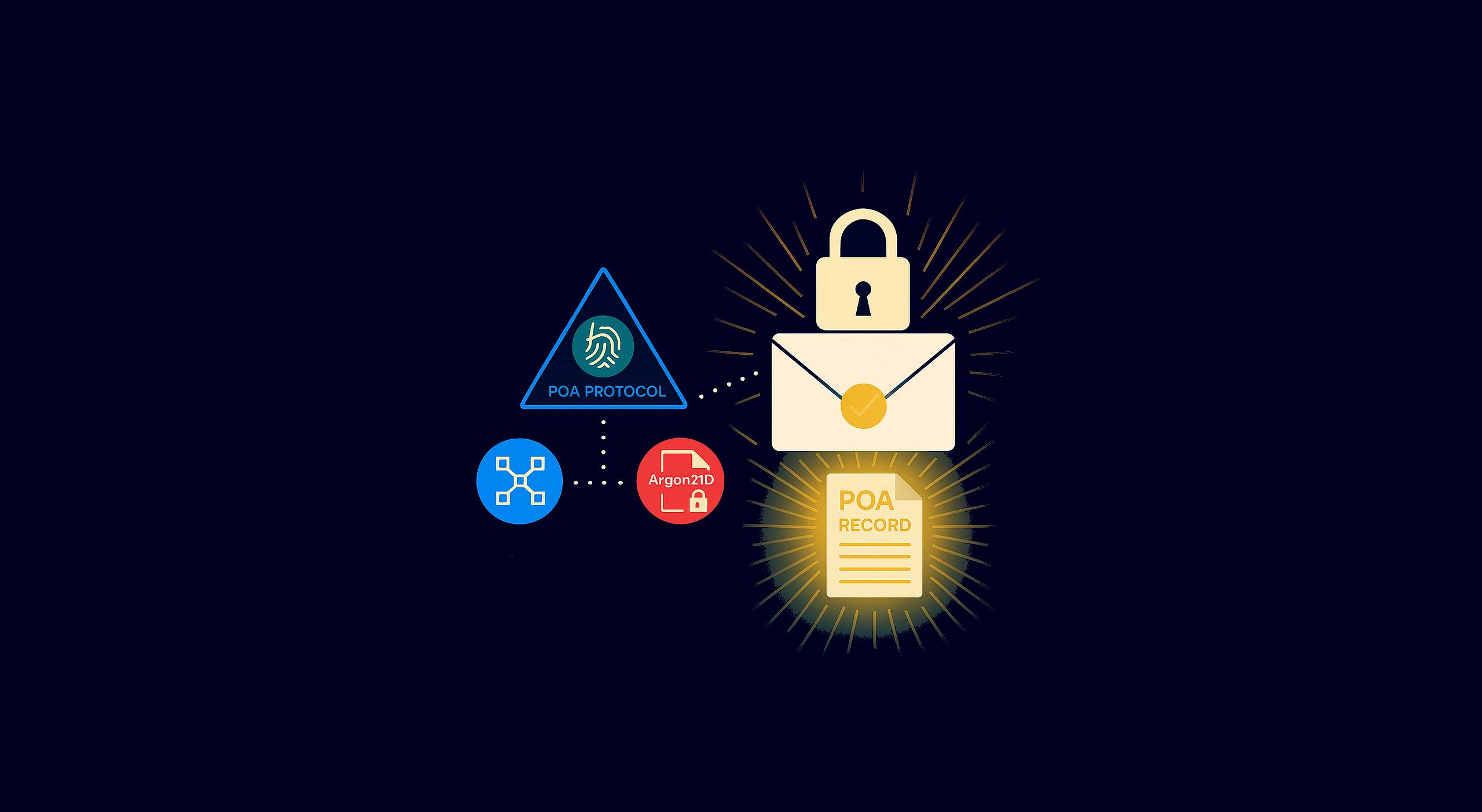
Proof of Authorship (POA) is that system: a reproducible, technology‑anchored framework that turns an authorship claim into an evidentiary artifact.
Two layers of POA
- POA Protocol
The reproducible process that generates proof. The protocol combines blockchain anchoring, IPFS content addressing, and quantum‑resistant encryption so every proof is produced through a transparent, verifiable workflow. It is designed to meet the reliability tests exemplified by U.S. Federal Rules of Evidence 901(b)(9). - POA Record
The evidentiary artifact produced by the protocol. The POA Record is a cryptographically anchored, immutable package that shows who created what, and when. It is portable, independently verifiable, and suitable for presentation in verification or legal contexts.
Core system features
- Blank exterior, sealed interior — When you create a protected asset, you assign a generic name that reveals nothing about the contents. This user-controlled “unmarked envelope” preserves confidentiality while the proof remains cryptographically secured, giving creators full control over disclosure.
- Quantum-resistant encryption — POA implements quantum-resistant algorithms aligned with NIST guidance. No encryption is guaranteed unbreakable forever, but these algorithms are selected to resist attacks from foreseeable quantum capabilities.
- Decentralized permanence — POA Records and their anchors are distributed across a decentralized network. There is no single point of failure; the proof persists even if individual nodes go offline or systems fail.
What the POA Record delivers
- Immutable evidence — Anchored and content‑addressed so any alteration is visible.
- Private until disclosure — Sealed by design and revealed only at the creator’s choice.
- Durable and discoverable — Persistently available across a distributed network.
- Engineered for admissibility — Generated through reproducible processes that map to established evidentiary reliability tests.
This is the 21st‑century sealed envelope: private, verifiable, and built to endure. POA moves creators from relying on ritual to holding court‑grade evidence.
Coming in our last post: Discover how POA transforms the balance of power between creators, publishers, and legal entities. Learn why this isn’t just about protection, but about strategic leverage in negotiations, simplified due diligence for businesses, and clear standards for courts. Join us next time as we explore the real-world impact of IPPS on the creative economy.