From Evidence to Infrastructure: What QTS Providers Should Know
Part 3 of 3
Part 1 asked which blockchain survives the courtroom?
Part 2 showed how POA and RaptorLockIP fortify QTS seals.
Part 3 explains what turns trust into evidence that actually works when challenged.
What Happens When Records Face Court
Blockchain vendors promise your records are “permanent” and “tamper-proof.” Then litigation starts, and opposing counsel asks five questions:
- Where is the actual evidence? (Not the hash, the actual document.)
- Who created it, when, and how do you prove that without your staff testifying?
- If I hire my own expert, can they verify this independently?
- What happens to these records if your company shuts down?
- Show me the complete history, who touched this, when, and what changed?
Most blockchain solutions collapse here. The evidence lives in a vendor database. The blockchain only stores a pointer. Custody is tracked in spreadsheets. Verification requires calling the vendor.
Courts don’t need blockchain promises. They need chain of evidence.
How Raptoreum Keeps Evidence and History Together
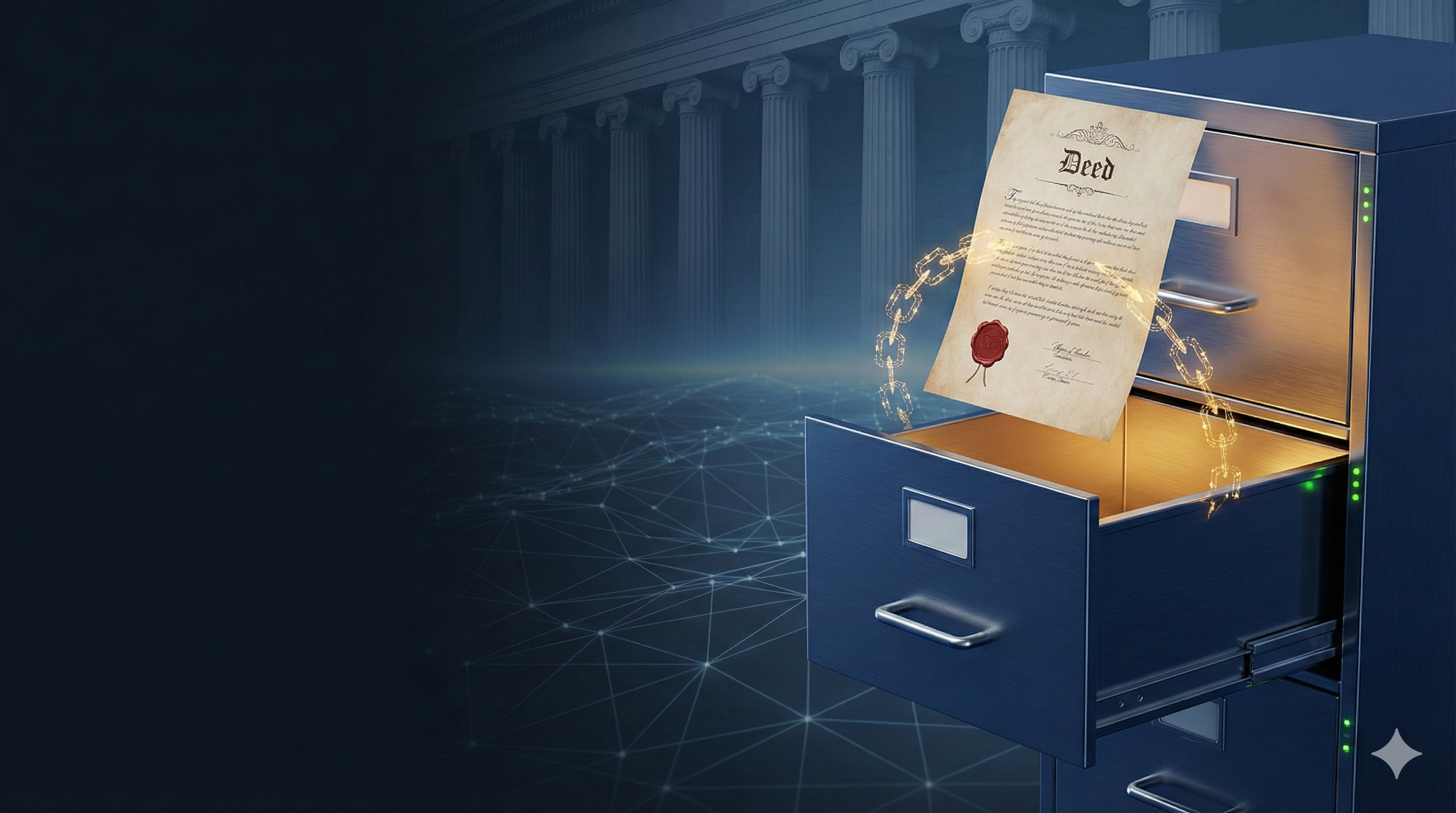
Raptoreum’s master and sub-asset architecture solves this. Think of it like a filing cabinet where every document and every action lives in the same locked drawer, timestamped and impossible to alter.
Master asset = the original record
A property deed. A patent. A contract.
Sub-assets = everything that happens next
Each update, transfer, or action creates a new sub-asset automatically linked to the master. All timestamped. All on-chain.
Example: A House Title
- Master asset: Original deed for 123 Main Street
- Sub-asset 1: First owner, Jane Smith, 2020
- Sub-asset 2: Sale to John Doe, 2022
- Sub-asset 3: Bank mortgage lien, 2022
- Sub-asset 4: Lien paid off, 2024
- Sub-asset 5: Sale to Maria Garcia, 2024
The complete history lives on the blockchain. Anyone can trace the chain. In court, you hand opposing counsel the master asset ID. They follow the sub-asset trail. The complete chain of custody is there, timestamped, cryptographically linked, verifiable by anyone.
That is alegal gold.
IPFS Built Into the Protocol
Raptoreum integrated IPFS as a first-class part of the Assets system from design through implementation. Files get a unique fingerprint (CID). That CID is anchored in the master asset on-chain. The blockchain proves when and who. The CID proves what and unchanged.
Why this matters: The CID is the canonical evidence handle. It is embedded in the protocol, not dependent on a vendor staying in business.
Files are pinned to multiple providers. If one goes offline, examiners retrieve from another. The evidence survives vendor exits.
RaptorLockIP Verify: Anyone Can Check, Anytime
An independent examiner (opposing counsel’s expert, a court-appointed auditor) does this:
- Download the file from IPFS using the CID
- Run RaptorLockIP Verify
- RaptorLockIP Verify confirms: local file bytes ↔ IPFS CID ↔ blockchain anchor
Time required: Under 30 minutes
Vendor cooperation needed: None
Testimony required: None
The record proves itself. That is self-authenticating evidence under eIDAS Article 41 and U.S. Federal Rules of Evidence 902.
The Infrastructure Layer
Raptoreum does not depend on a single server or vendor staying in business. If RaptorLockIP exits, the blockchain remains with:
- Multi-provider pinning: Files stored on multiple independent IPFS providers
- Smartnode network: Distributed nodes serve blockchain data and back explorers
- Chainlocks: Near-instant finality, timestamps are cryptographically locked
- Quantum-resistant encryption: Records remain secure and verifiable across decades
This is legal resilience by design.
Why This Becomes Civic Infrastructure
When verification is universal, independent, and permanent:
- Property registries: Title as master, every sale as sub-asset. No clerk testimony.
- Corporate records: Incorporation as master, resolutions as sub-assets. Regulators verify independently.
- Creative works: Original as master, licenses as sub-assets. Provenance survives the creator.
- Municipal contracts: Contract as master, amendments as sub-assets. Auditors verify years later without staff testimony.
The system outlasts any single vendor.
Questions Worth Asking Any Blockchain Vendor
When evaluating blockchain solutions, these questions reveal whether you are getting infrastructure or vendor dependency:
- Are assets integrated at the protocol level? (Or bolted on via vendor API?)
- Can I create assets and attach files using the core wallet? (Or only through vendor web apps?)
- Where does the actual evidence live? (On-chain/IPFS, or in vendor databases?)
- Is the evidence pinned to multiple independent providers? (Or just “we handle storage”?)
- Can independent examiners verify without calling you? (Or must they “contact support”?)
- How is custody tracked? (On-chain sub-assets, or external logs?)
- What happens if you exit? (Does evidence survive, or must it be “migrated”?)
- Show me the verification process. (Can you give me an asset ID and let me verify it now?)
The answers reveal whether the solution will survive adversarial testing.
Lasting Considerations
Courts care about evidence, custody, and whether a second examiner can verify your claims without your help.
Most blockchain solutions fail because files live in vendor databases, custody is tracked externally, and verification requires vendor cooperation. When the vendor exits or changes terms, the evidence disappears with them.
POA and RaptorLockIP solve this because Raptoreum built it into the protocol:
- Master/sub-asset architecture creates automatic custody trails
- Protocol-level IPFS integration makes the CID the canonical evidence handle
- Multi-provider pinning ensures evidence survives vendor exits
- RaptorLockIP Verify enables mechanical, independent verification in under 30 minutes
- Self-authentication meets eIDAS and FRE 902 standards
Consider a property title dispute: Master asset holds the deed CID on-chain. Every sale, lien, and release becomes a timestamped sub-asset. An examiner downloads the deed from IPFS, verifies the hash matches the blockchain anchor, and traces the complete custody chain. Thirty minutes. No vendor calls. No testimony. Just reproducible facts.
That is the difference between blockchain promises and evidence that survives in court.
QTS providers fortify statutory trust. When you anchor that trust to blockchain-complete evidence with protocol-level integration and infrastructure-grade resilience, you move from compliance documents to civic infrastructure. Permanent records trusted by institutions that outlast any single vendor.
POA and RaptorLockIP deliver that foundation. Courts will expect it. QTS providers should know it exists.
Note:
This post can be found as an asset at:
https://raptorlockip.com/explorer/asset/dc9929d3152cdbbdb85b19762e8403cfbc37139ca3301f3c644ff2329dc72676
This post is stored in the IPFS Server under Hash:
https://ipfsweb.raptoreum.com/ipfs/QmNuDHYTwwV7iWY6ov2f49qBGkziZaxeDDrgUkxeeF72wv